
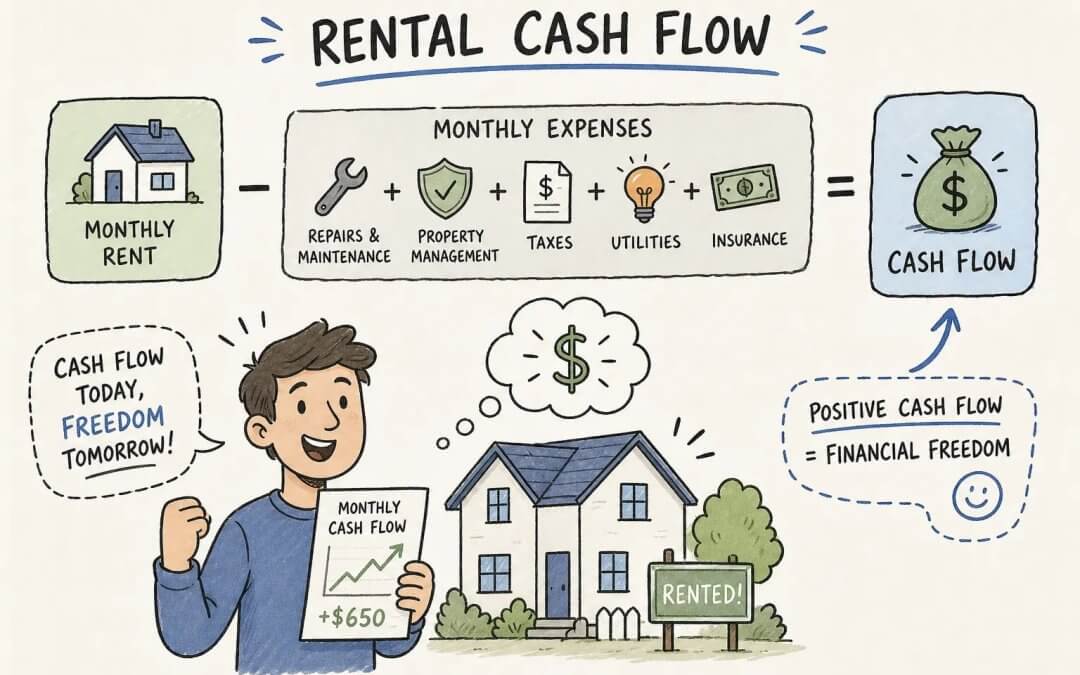
The rental property cash flow formula for beginners is: monthly rent, minus vacancy, minus operating expenses, minus your CapEx reserve, minus your mortgage payment. That’s it. If the number left over is positive, the property puts money in your pocket each month. If it’s negative, you’re subsidizing it out of your own income. Before you close on any deal, run this calculation with every real number you can find.
At the Empowered Investor Network, our investment counselors work through this exact formula alongside new investors during their initial consultations. This article walks you through every line, shows you which expense percentages to use, and gives you a full worked example you can copy on a notepad right now.
Key takeaways
- Five-line formula: Gross rent minus vacancy, minus operating expenses, minus CapEx reserve, minus mortgage equals your monthly cash flow.
- NOI as a middle step: Net Operating Income separates property economics from your financing terms, making deal comparisons cleaner.
- Vacancy and CapEx are not optional: As a conservative default, use at least 7% of gross rent for each on a standard single-family rental; adjust based on local market data.
- Cash-on-cash return: Divide annual cash flow by total cash invested; a commonly cited beginner benchmark in 2026 is 8% to 10%, though acceptable targets vary by market and investor objectives.
- The full picture: Cash-on-cash return excludes appreciation, loan paydown, and tax benefits, so treat it as a starting point, not a final verdict.
What the rental property cash flow formula for beginners actually looks like
Write these five lines on a piece of paper: gross monthly rent, minus a vacancy allowance, minus all monthly operating expenses, minus a capital expenditure reserve, minus your monthly mortgage payment (principal and interest). Fill them in for any property you’re evaluating. That structure is your entire formula, and nothing about it is complicated.
How NOI fits into the cash flow formula for rental property beginners
Before subtracting debt service, many experienced investors first calculate Net Operating Income, or NOI. NOI equals effective rental income (rent minus vacancy) minus operating expenses. It tells you how the property performs independent of your financing. Then cash flow equals NOI minus your CapEx reserve minus your mortgage payment. This two-step approach helps you separate the property’s economics from your own loan terms, which matters when you compare deals financed differently or want to know whether the asset itself makes sense before you even talk to a lender.
Annual cash flow is simply monthly cash flow multiplied by 12, assuming consistent rent and expenses throughout the year. Some investors prefer to model annually because property taxes, insurance renewals, and other costs bill once a year. Either scale works fine, just make sure all your inputs are on the same time scale before you run the numbers, or you’ll mix monthly and annual figures and get a result that means nothing.
Which expenses belong in your cash flow calculation?
Property taxes, landlord insurance, property management fees, routine maintenance, and owner-paid utilities all belong in your monthly operating expenses. If the property has an HOA, that goes in too. Property management fees in Sun Belt and Midwest markets typically run 8% to 12% of collected monthly rent, though exact fees vary by metro and service scope. Even if you plan to self-manage, include that fee anyway. It tells you the property’s true economic performance, and it protects you if circumstances ever change and you need to hire a manager.
Vacancy is technically a reduction of potential income, not an expense, but it must appear in your model. If a unit sits empty for three weeks between tenants, that lost rent is real money, and it hits your bank account just as hard as any bill. CapEx covers major, infrequent replacements: roofs, HVAC systems, water heaters, appliances. These don’t happen every month, but they will happen. Setting aside a monthly reserve means you’re never blindsided. Keep vacancy and CapEx visually separate from your recurring operating expenses so you can see exactly where your money goes.
Mortgage principal and interest are not operating expenses. Subtract them after you’ve calculated NOI. Income taxes and depreciation also stay out of the property-level formula. Depreciation reduces taxable income without touching your cash, which improves your after-tax position, but it belongs in a separate tax analysis rather than in the cash flow model you’re using to evaluate a deal. Don’t mix layers; keep the formula clean.
What vacancy and CapEx percentages should you actually use?
For a stabilized single-family rental in an average market, use 7% of gross rent for vacancy and 7% of gross rent for CapEx reserves as a conservative starting point; adjust both figures using local market data. The national single-family rental vacancy rate averaged roughly 6% across the first half of 2026, based on Census Bureau occupancy data, so 7% gives you a small cushion above that baseline.
In tight, low-turnover markets you can shade vacancy down to 5%. For older properties, deferred-maintenance homes, or markets with higher tenant turnover, push CapEx up to 10% and vacancy to 10% to 12%. Avoid modeling zero vacancy; plan for turnover and credit loss, since even a well-managed property loses rent between tenants. Inflating your income projections by ignoring vacancy is one of the most common beginner mistakes, and it’s also one of the easiest to fix: just add the line.
A worked example you can replicate right now
Here is how the numbers lay out.
Rental income minus expenses: the full five-line breakdown
| Line item | Monthly amount |
|---|---|
| Cash-on-cash return | −0.1% |
When you run the full five-line formula, including a dedicated CapEx reserve and a corrected maintenance figure, this property essentially breaks even. That is the rental property cash flow formula for beginners doing exactly what it’s supposed to do: surfacing the truth before you wire a down payment. Leave any expense line out and the number looks better than reality. Leave all of them in and you get an honest answer.
This example also illustrates why the total cash invested figure matters. The denominator includes not just the down payment but also closing costs, because every dollar you brought to the table is a dollar your cash flow has to justify. Omitting closing costs from the denominator would make the return appear higher than it really is, which serves no one except a seller trying to close fast. A deal that barely breaks even at today’s purchase price tells you to negotiate the price down, find a higher-rent property, or look at a different market.
Does a good cash-on-cash return actually tell you whether the deal is worth buying?
Cash-on-cash return lets you compare a rental deal to other investments on an apples-to-apples basis, but it doesn’t tell the whole story. Many experienced investors target a minimum of 8% to 10% in strong rental markets, with 6% to 8% acceptable in expensive, high-appreciation markets where rent growth is a reasonable expectation, though acceptable thresholds vary by market and individual investor objectives. The worked example above sits at essentially breakeven, well below those thresholds.
What cash-on-cash return doesn’t capture is the broader return picture: principal paydown, potential appreciation, and the inflation-hedging characteristics of real estate. Over time, rent increases while your fixed mortgage payment stays flat, which improves cash flow without you doing anything active. A property with modest initial cash-on-cash return can look very different five or ten years in. That said, never bank on appreciation alone. If the cash flow doesn’t work at today’s numbers, the deal needs renegotiation or rejection, not optimism.
One final point: a projected cash-on-cash return above 12% to 15% deserves extra scrutiny. High numbers often reflect omitted vacancy, missing CapEx reserves, underestimated management fees, or unrealistic rent projections. Conservative underwriting that produces a lower return is safer than aggressive assumptions that produce a compelling number on paper and a cash shortfall in practice.
How to run these numbers confidently before making an offer
The Empowered Investor Network provides tools and resources for calculating rental property numbers. You enter the purchase price, expected rent, and loan terms, and the tool helps you work through realistic expense estimates. That removes the guesswork around which percentage to use for management or how much to budget for property taxes in a particular state. Getting those numbers right before any earnest money leaves your account is the whole point.
A free calculator gives you the structure. An investment counselor gives you the judgment. Our team pairs new investors with dedicated counselors who know rental markets from the Sun Belt to the Midwest. Dedicated investment counselors guide clients through deal analysis and model how changing rents or rates affect returns. For a first-time investor, that second set of eyes before you wire a down payment is worth more than any spreadsheet. Book a free consultation to run the formula on a real deal with someone who knows what the numbers should look like.
Run the rental property cash flow formula every time: no exceptions
The rental property cash flow formula for beginners is not complicated. Rent minus vacancy minus operating expenses minus CapEx reserve minus mortgage equals your monthly number. Run it honestly, with realistic vacancy and CapEx assumptions, and you’ll know immediately whether a property is worth pursuing or worth walking away from.
Drop any property’s real numbers into that same five-line structure and you have an honest answer in minutes.
The Empowered Investor Network offers free investment consultations and tools to help investors test deals. Reach out and run the rental property cash flow formula on a real property before you sign anything. The formula is simple. The discipline to apply it on every deal is what separates investors who build wealth from those who learn expensive lessons.
Frequently Asked Questions
How often should we recalculate cash flow for a property we already own?
Recalculate whenever one of the key inputs changes, and at least whenever rent, taxes, insurance, or loan terms change. We also recommend checking annually since some costs like property taxes and insurance renewals often bill once a year and can shift your numbers if you mix monthly and annual inputs.
How should we handle closing costs when calculating cash-on-cash return?
Include closing costs in the total cash invested denominator when you calculate cash-on-cash return. We count every dollar you brought to the table, because omitting closing costs would make the return appear higher than it really is and distort your comparison to other investments.