
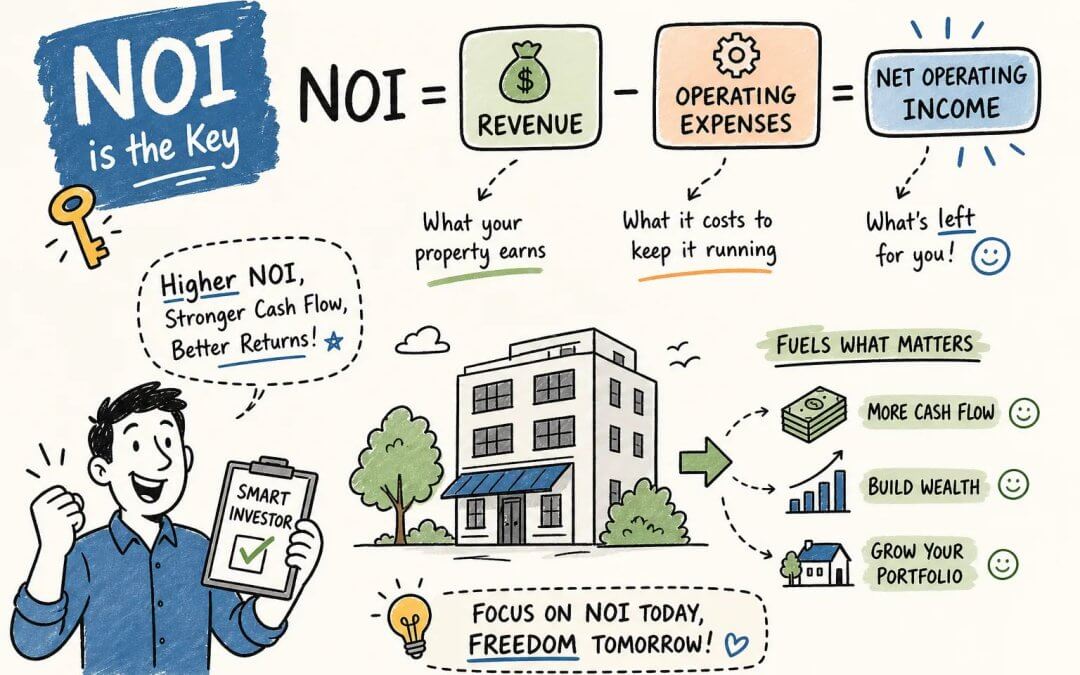
NOI in real estate stands for net operating income. The formula is Effective Gross Income minus Operating Expenses. That single number tells you what a property earns from its operations, before any mortgage payment, depreciation, or income tax enters the picture. It is a widely used measure of a property’s operating earning power.
Experienced investors often focus on NOI rather than superficial details like neighborhoods and paint colors. The Empowered Investor Network offers personalized investment counseling.
Here’s exactly what goes into that number, how to calculate it, and how to use it to value and compare properties like a professional.
Key takeaways
- The core formula: NOI equals Effective Gross Income minus Operating Expenses, calculated before debt service, depreciation, and income taxes.
- What stays out: Mortgage payments, capital expenditures, depreciation, and income taxes are excluded from NOI by design. They measure ownership, not operations.
- Cap rate connection: Property value equals NOI divided by cap rate. A higher NOI means a higher valuation at any given cap rate.
- Small NOI gains produce large swings in what a property is worth.
- Margin benchmarks: Stabilized multifamily typically runs 55 to 65%; industrial assets under NNN leases often reach 70 to 85%.
- Six levers to improve it: Rent audits, occupancy gains, utility recovery, vendor rebidding, preventive maintenance, and turnover reduction all move NOI without requiring a major renovation.
What actually goes into NOI, and what gets left out
Income belongs above the line when it is property-generated and reasonably recurring. Start with potential rental income, subtract vacancy and credit loss, and you have your effective rental income. Then add any ancillary sources: parking fees, laundry income, storage rent, pet fees, and tenant utility reimbursements all count when they are consistent and property-level.
Operating expenses that reduce NOI follow a consistent test: is the cost recurring, property-level, and necessary to operate the asset? The following expense categories all meet that standard:
- Property taxes
- Insurance
- Repairs and maintenance
- Property management fees
- Owner-paid utilities
- Landscaping
- Security
- Marketing
- Payroll for onsite staff
If you self-manage, include a market-rate management fee anyway. Skipping it overstates the property’s true performance, and any serious buyer or lender will add it back.
Where beginners go wrong is on what gets excluded. Mortgage principal and interest stay out because they are financing decisions, not operating realities. Depreciation and amortization are noncash accounting entries. Major capital expenditures, like a full roof replacement or an HVAC system overhaul, are capital decisions made below the NOI line. Income taxes, leasing commissions, and tenant improvement allowances are also excluded. NOI is a property metric, not an owner metric. It strips out everything specific to how you financed or structured the deal.
NOI real estate formula: how to calculate it step by step
The NOI formula written out cleanly: NOI equals Potential Rental Income minus Vacancy and Credit Loss plus Other Recurring Income, minus Operating Expenses. You can also express it as Effective Gross Income minus Operating Expenses. Both versions produce the same result; use whichever keeps your spreadsheet cleaner.
Income
Start by projecting potential rental income at full occupancy, then subtract your vacancy and credit loss allowance. Add any reliable ancillary income streams to arrive at Effective Gross Income.
Expenses
List every recurring, property-level operating cost. Do not include mortgage payments, capital expenditures, or depreciation. Sum those costs to get your total Operating Expenses.
Worked example
Run a quick sanity check by dividing NOI by Effective Gross Income to get your NOI margin. Something is either inflated on the income side or missing on the expense side.
How NOI connects to cap rate and property value
The direct capitalization formula ties NOI directly to what a property is worth. Cap Rate equals NOI divided by Property Value. Rearranged to find value: Property Value equals NOI divided by Cap Rate. This is how commercial appraisers and lenders underwrite income-producing real estate, and it is how sophisticated buyers decide what to pay.
Cap rate and value move in opposite directions: a lower cap rate market produces higher property values for the same income stream.
The income increase gets multiplied by the market cap rate when buyers price the deal.
What a healthy NOI margin looks like by asset class
NOI margin tells you how efficiently a property converts gross revenue into operating income. The benchmarks vary by asset class because lease structure, tenant obligations, and operating intensity differ significantly across property types.
| Asset class | Typical NOI margin |
|---|---|
| Multifamily | 55–65% |
| Industrial | 70–85% |
| Office | 45–65% |
| Retail | 55–80% |
Industrial runs the highest because triple-net leases push most expenses directly to tenants, leaving the landlord’s remaining costs minimal. Office runs lower on gross leases because landlords absorb utilities, janitorial services, and common-area costs. Multifamily sits in the middle, with Class A properties that carry heavy amenity packages tending toward the lower end of the range.
Use these benchmarks as a quick filter before you spend time on a full underwrite. If a seller’s pro forma shows a 72% NOI margin on a multifamily deal, that number deserves hard scrutiny. Either expenses are being understated or income is inflated. Neither is a good sign, and both are common in listing materials designed to maximize the asking price.
Six proven ways to push your NOI in real estate higher
On the revenue side, start with a unit-by-unit rent audit against current comparable listings. Apply the largest increases to below-market units first.
Improve occupancy by starting renewals 90 to 120 days early and setting measurable notice-to-ready timelines. Then add ancillary income where local law permits. Utility bill-back programs, parking fees, storage rent, and pet fees compound quickly.
On the expense side, rebid landscaping, pest control, janitorial, trash, and maintenance contracts every 12 to 24 months.
Contest property tax assessments when the valuation is inaccurate, that is money left on the table every year.
The combined impact of these levers is significant. NOI improvement is the real value-add play in real estate. No major renovation required.
How to run the numbers before you commit
The most common failure mode is falling in love with a property first and then trying to make the numbers work backward. Run the NOI calculation for real estate first, before the emotional attachment sets in, and you will avoid overpaying for a property that looks good on the surface but bleeds cash in year one. Never rely on a seller’s stated NOI without rebuilding it from leases, rent rolls, tax records, insurance quotes, and actual operating statements.
The Empowered Investor Network provides free investment consultations with dedicated counselors. The platform connects investors with local market specialists. For investors buying out of state, that local data is what turns a projection into a real underwrite rather than an optimistic guess. Use our free tools and AI resources to run your own numbers, then bring your questions to a counselor before you make an offer.
Start with the numbers, not the neighborhood
NOI is not a complicated concept. It is Effective Gross Income minus Operating Expenses, before debt and taxes. What makes it powerful is what it filters out: everything specific to your financing, your tax situation, and your accounting choices. What remains is the property speaking for itself.
NOI also drives valuation. Understand it and you understand how to both buy and improve income-producing real estate. A higher NOI at the same cap rate means a higher price when you sell. The six levers above, used consistently, move that number in meaningful ways without requiring a full gut renovation.
Before you make an offer on your next property, run the NOI real estate numbers first. If you want experienced eyes on those numbers, the Empowered Investor Network’s counselors and free tools are there for exactly that purpose. Reach out for a free consultation and walk through the numbers on a real deal before you commit to anything.
Frequently Asked Questions
How often should we recalculate NOI for a property we own?
Recalculate NOI whenever your effective gross income or recurring operating expenses change materially. We recommend running the calculation at lease renewals, after rebidding vendor contracts, or when you add ancillary income streams so your underwrite reflects current rents, vacancy assumptions, and recurring costs.
If we self-manage a property, should we still include a management fee in NOI calculations?
Yes, include a market-rate management fee even if you self-manage. We state that skipping it overstates performance and that any serious buyer or lender will add it back, so include that fee to show true property-level operating results.
Do one-time items like insurance claim proceeds or a temporary rent concession affect NOI?
No, NOI only includes property-generated, reasonably recurring income and recurring property-level operating costs. Nonrecurring items, capital expenditures, depreciation, and owner-specific items are excluded because NOI is designed to measure operating earning power, not one-off events or ownership decisions.
Can we use NOI to compare properties across different asset classes directly?
You can compare properties using NOI, but you must account for typical NOI margin differences by asset class. We provide benchmark margins, multifamily 55–65%, industrial 70–85%, office 45–65%, retail 55–80%, so use those ranges to screen deals before a full underwrite and be skeptical of pro formas that deviate sharply from these norms.