
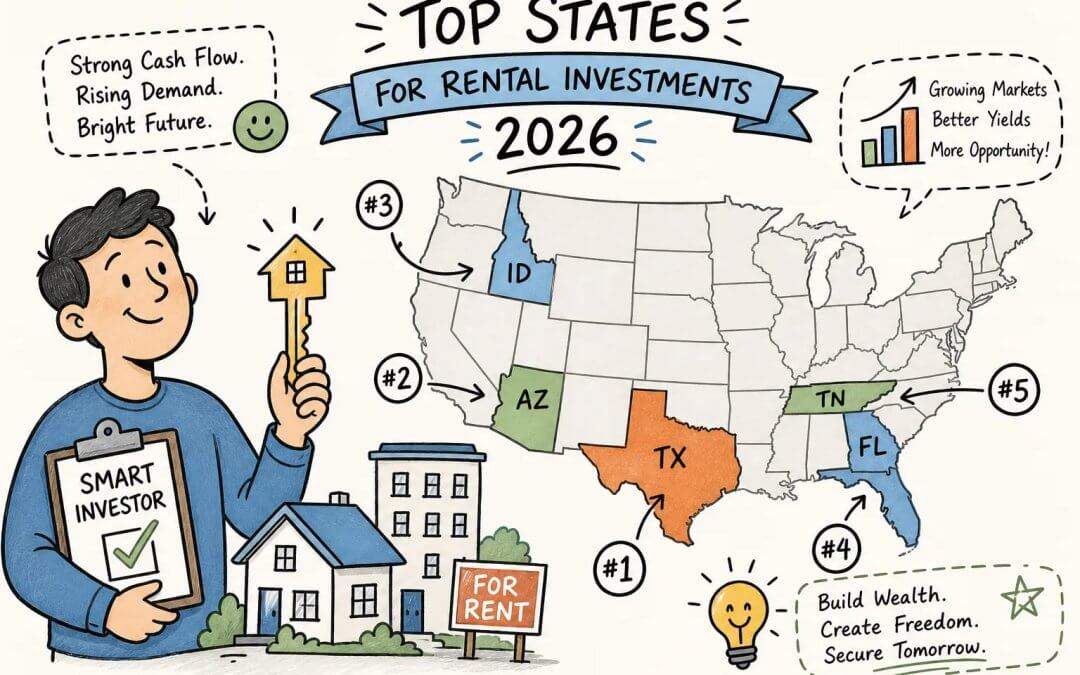
What is the best state to buy rental property in 2026? It depends on whether you want cash flow today or appreciation over the next decade. Most investors never ask that question clearly enough. Instead, they pick a state based on where they live, where a friend made money, or a headline they half-read. That’s how you end up owning a rental in a market with a 3.5% cap rate and a landlord-tenant law that turns a routine nonpayment into a six-month legal ordeal. The better approach starts with the data, and in 2026, the data points in two clear directions.
Two clusters dominate rental investing this year. Midwest markets offer strong cash flow, low entry prices, and rent-to-price ratios that coastal investors rarely see at home. Sun Belt markets offer something different: migration-fueled rent growth, population momentum, and long-term appreciation potential. The question isn’t which cluster is better. It’s which one fits your goal. This guide walks through the metrics, the states, and the decision process so you can answer that question with data instead of a gut feeling.
What is the best state to buy rental property in 2026? Start with the right metrics
Before ranking any state, you need the right filter. Two investors with different goals should be looking at different numbers. The investor chasing cash flow today needs different data than the one building equity over a decade. That said, a handful of metrics apply to both.
Cap rate and rent-to-price ratio: what they actually tell you
The cap rate is net operating income divided by purchase price. The rent-to-price ratio is monthly rent divided by purchase price. These are the two fastest filters for evaluating a state’s income potential. A strong rent-to-price ratio in 2026 sits at roughly 0.8% or higher per month. Coastal markets routinely fall below 0.4%, which is why California and New York rarely make the list for cash flow investors. By contrast, Mississippi comes in at 6.0% gross annual yield and Texas at 5.8%, using 2026 median home values and Fair Market Rent data.
Cap rate matters most when you apply it fully loaded. A property that looks like an 8% cap rate at purchase can shrink to 5% once you factor in local property taxes, insurance, vacancy, and management fees. Never evaluate cap rate in isolation. Run it with realistic holding costs for the specific county, not just a statewide average.
Population growth, job markets, and why tenant demand follows both
Net domestic migration is one of the most reliable leading indicators for future rent pressure and vacancy rates. When people move into a state faster than housing supply can absorb them, rents rise and vacancy drops. That’s the condition every rental investor wants. Census Bureau data from 2024 to 2025 shows North Carolina leading all states with a net domestic migration gain of 84,064 people, followed by Texas at 67,299 and South Carolina at 66,622. Tennessee added 42,389. These aren’t rounding errors. They represent a sustained, structural shift in where Americans choose to live and work.
Strong migration protects appreciation investors by maintaining demand under their asset. It also benefits cash flow investors by keeping vacancy low and supporting rent growth over time. The states showing the strongest migration numbers in 2026 overlap almost entirely with the states showing the strongest landlord-friendly legal environments, which is not a coincidence.
Midwest states dominating cash flow in 2026
The Midwest doesn’t get glamorous coverage in real estate content about passive income. These states won’t trend on social media. But if the goal is raw cash flow with low purchase prices and rent-to-price ratios that actually work, the Midwest outperforms everywhere else in the country right now.
Ohio and Michigan: the yield leaders
Ohio and Michigan consistently post the highest cap rates for single-family rentals among the best cash flow states in 2026. Cleveland and Akron typically yield cap rates in the 7.5% to 9% range. Detroit comes in higher, often 8% to 10%, depending on neighborhood and property condition. Ohio’s statewide median home price sits at roughly $274,855, with median rents near $1,300 per month, which gives investors a workable starting point for underwriting. The math here is real. These are not promotional figures from a property developer. They reflect what investors are actually paying and actually collecting.
The risks in these markets are also real and should be addressed directly. Property condition, neighborhood selection, and local property management matter more in rust belt metros than in appreciation-driven markets. A poorly managed Cleveland rental in a declining neighborhood is not the same investment as a well-selected one in a stabilizing neighborhood with improving employment. You need local eyes on both the deal and the management before you commit.
Alabama, Missouri, and Tennessee: solid yields with a more stable base
Birmingham, St. Louis, and Memphis combine cap rates in the 8.5% to 9.2% gross range with a more stable economic foundation than the top rust belt metros. Birmingham comes in near 8.8% to 9.2% gross. St. Louis runs around 8.6% gross. Memphis sits at roughly 8.5% gross. Alabama and Missouri both rank highly on landlord-friendliness, with Alabama placing fourth nationally and Missouri tenth, based on landlord-friendliness index data for 2026. That legal environment is a margin-of-safety factor that doesn’t show up in the cap rate but matters significantly over a multi-year hold.
Tennessee and Memphis specifically occupy an interesting position. They straddle the line between Midwest-style cash flow and Sun Belt migration dynamics. Tennessee added over 42,000 net domestic migrants in a single year, and Memphis still posts cash flow numbers that appreciation markets can’t match. For investors who want exposure to both dynamics without committing entirely to one cluster, Tennessee is worth serious consideration.
Sun Belt states built for appreciation and tenant demand
The Sun Belt story in 2026 is a migration story. People are still moving south and southeast in large numbers, and that shift is not reversing. For the investor building toward long-term equity, these states offer rent growth potential and home value appreciation that Midwest markets typically can’t match.
The Carolinas: migration-fueled rent growth with landlord-friendly laws
North Carolina and South Carolina represent the strongest combination of in-migration, rent growth potential, and landlord-friendly legislation in the Southeast. South Carolina was the fastest-growing state by percentage in 2024 to 2025, with a net domestic migration gain of over 66,000 people in a single year. North Carolina topped all states in absolute domestic migration, adding 84,000 net new residents. Charlotte, Raleigh, Greenville, and Charleston are the primary investment metros, each with active rental demand and a growing employment base. Neither state has statewide rent control. Both rank in the top 12 nationally for landlord-friendly legislation.
Cap rates in the Carolinas are lower than their Midwest counterparts, typically in the 5% to 6.5% range for single-family rentals, which reflects the appreciation premium built into purchase prices. For the investor with a five-to-ten-year horizon, that tradeoff makes sense. You’re buying rent growth and equity appreciation, not maximum cash flow on day one. Know which outcome you’re underwriting before you pick the market.
Texas and Florida: scale and tenant depth, with one important caveat
Texas is one of the few states that delivers reasonable rent-to-price ratios at scale, posting a 5.8% gross annual yield against a median home value of about $303,000. The state has no income tax, consistently ranks among the most landlord-friendly states in the country, and has eviction timelines averaging 21 to 28 days. Population growth remains robust, with 67,000 net domestic migrants in 2024 to 2025. For investors building a multi-state portfolio, Texas offers something rare: size, liquidity, and landlord protections in the same package.
Florida tells a more complicated story. The landlord legal environment remains favorable, with no statewide rent control and fast eviction timelines. But natural-disaster insurance premiums have become a material factor in coastal Florida markets, and they must be underwritten accurately before you calculate actual cap rate. A property that appears to yield 6.5% gross can drop to 4.5% net once wind and flood insurance are factored in. Inland Florida markets carry less insurance exposure and are worth separating from the coastal analysis entirely.
What landlord laws and property taxes quietly do to your returns
A rental property’s gross yield means nothing if the legal environment and holding costs hollow it out. This is where many investors, particularly first-timers buying remotely, get hurt. The two factors that matter most are the state’s landlord-tenant legal framework and its effective property tax rate.
Rent control and eviction law: the states to approach with caution
California, Oregon, and Washington have active statewide rent caps as of 2026. New York, New Jersey, Maryland, Minnesota, and Maine allow local rent stabilization programs that constrain returns in ways that don’t appear in the cap rate calculation. What rent control means practically: limited rent increases, complicated eviction processes, and regulatory uncertainty that can make a performing property difficult to exit or reposition. Contrast that with states like Texas, Indiana, Alabama, Georgia, Tennessee, and both Carolinas, where eviction timelines run 14 to 35 days and security deposit rules are straightforward. The legal environment is a component of total return. Price it accordingly.
Property tax rates: the holding cost most investors underestimate
New Jersey and Illinois both sit at approximately 1.88% effective property tax rate, the highest in the country. North Carolina comes in at 0.66%. Tennessee’s effective rate is also materially lower than the national average, particularly when assessed value formulas are applied. That spread between a low-tax state and a high-tax state can represent thousands of dollars annually on a single property, which flows directly into or out of your net operating income. Always underwrite the county-level property tax rate, not just the state average. County-level variation within a state can be significant.
How to pick the best state to buy rental property in 2026 for your situation
A ranked list of states is a useful starting point. The purchase decision happens at the metro level, then the neighborhood level, then the specific property. The sequence below moves an investor from a list like this one to a closed deal.
A five-step framework for picking your market
Start by defining your primary goal. Cash flow today or appreciation over time? That answer determines your region. Midwest investors should optimize for yield; Sun Belt investors should optimize for growth. The Carolinas and Tennessee offer a reasonable version of both, with some compromise on each side. Don’t try to optimize for both simultaneously in the same market without accepting that you’ll likely achieve neither fully.
Second, run the rent-to-price ratio and estimated cap rate for specific metros within your target states. Statewide averages mask enormous variation. A state average means nothing if the specific metro you’re buying in runs 1.5 points lower than the headline number.
Third, check landlord laws and effective property tax rates at the county level, not just the state level. Some counties within landlord-friendly states have local ordinances that complicate the legal picture.
Fourth, evaluate the local employment base. A single major employer driving a market creates concentration risk. Diversified local economies with multiple industry sectors provide more durable rental demand.
Fifth, get eyes on the ground through a local market specialist before making an offer. Publicly available data tells you which states are strong. It doesn’t tell you which streets, which property conditions, or which neighborhoods actually deliver the numbers you’re modeling.
Why local market knowledge is the real competitive edge
This is the wall most remote investors hit. The data points you to Ohio or the Carolinas. But then the question becomes which part of Cleveland, which price tier in Charlotte, which property type in Birmingham. That’s not answerable from a laptop in California. The Empowered Investor Network addresses this directly through a network of vetted local market specialists operating in the specific markets featured in this guide, paired with dedicated investment counselors who help investors match their goals to specific market conditions. If you’re targeting cash flow in Ohio or appreciation in the Carolinas, that ground-level intelligence is what separates a spreadsheet exercise from an actual portfolio.
The bottom line on what is the best state to buy rental property in 2026
Picking the best state to buy rental property in 2026 comes down to your investment goal, your risk tolerance, and your willingness to underwrite the full cost picture rather than headline yields. The Midwest wins on pure cash flow. The Sun Belt wins on migration-fueled appreciation. Tennessee, Texas, and the Carolinas offer a reasonable version of both, with the legal environments to support long-term ownership.
The worst outcome is paralysis. Pick a goal, run the numbers on three to five specific metros, check the legal environment, and talk to someone with genuine local market knowledge before you commit. The data in 2026 points clearly to strong opportunities in markets that most coastal investors have never seriously considered. That gap between awareness and action is exactly where portfolio-building wealth gets created. Book a free consultation with The Empowered Investor Network and get a counselor who knows your target market on the phone before you make a move. The team works with investors at every stage, from picking a target state to closing on a specific property, with local specialists in the markets that actually make sense for your numbers.