
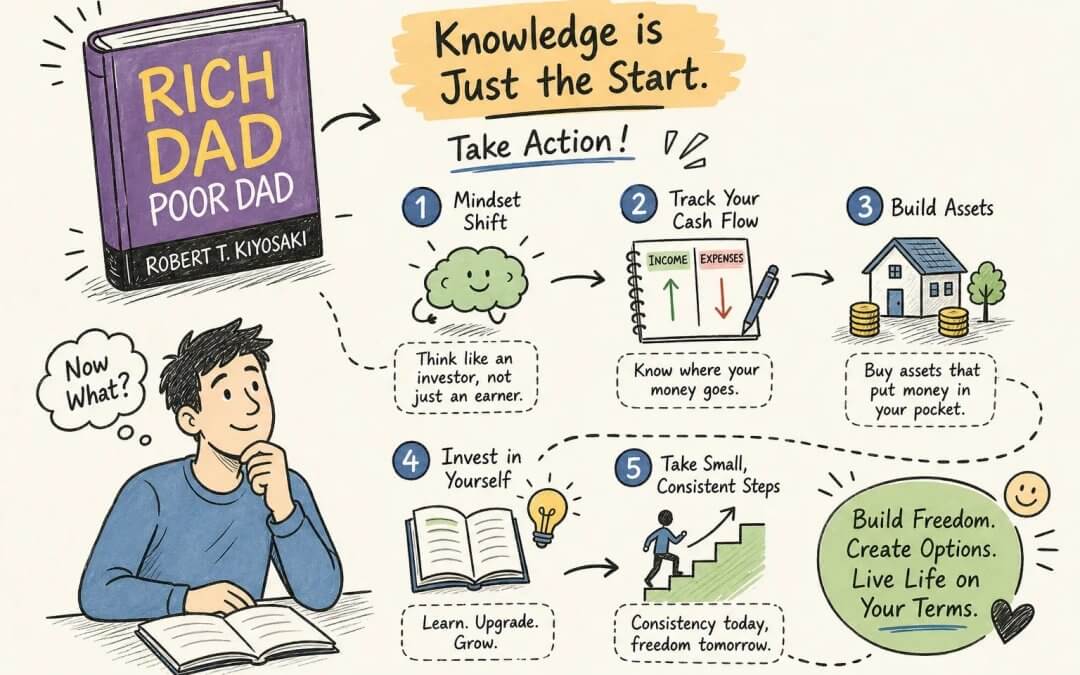
The book did its job. Rich Dad Poor Dad gives you three clear directives: buy assets, build financial literacy, and stop trading time for money. That framework is genuinely useful. What it does not give you is a single concrete action, no market to look at, no deal to analyze, no person to call. Many readers finish it energized and then do nothing, not because they lack commitment, but because inspiration without execution is just a feeling.
This article is the bridge between finishing the book and owning your first income property. The Empowered Investor Network helps readers make exactly that transition. The steps are straightforward, define your goals, run a financial snapshot, choose target markets, get preapproved, and review vetted properties. But they do require honesty about where you currently stand and a willingness to work with real numbers in real markets.
Key takeaways
- Assets vs. liabilities: Kiyosaki’s core distinction is blunt but accurate. An asset puts money in your pocket; a liability takes it out. Apply that lens to everything you own.
- Financial literacy matters: Understanding cash flow, net operating income, and cash-on-cash return separates real investors from wishful thinkers.
- The book is incomplete by design: It changes your mindset, not your portfolio. Execution requires market data, deal analysis, and experienced guidance.
- Your local market may not work: Coastal investors often cannot cash-flow locally. Sun Belt and Midwest markets consistently produce better numbers at lower entry prices.
- Know your numbers first: Credit score, available down payment, and post-closing reserves determine which markets and financing options are realistic for you right now.
What Rich Dad Poor Dad actually got right
Kiyosaki’s asset/liability distinction is blunt by design, and that bluntness is its value. An asset puts money in your pocket; a liability takes money out. Run that test on your car, your primary home, and your savings account while inflation chips away at every dollar sitting idle. The results are uncomfortable for most people, and uncomfortable is exactly where useful thinking starts.
The book argues that most people are financially illiterate, rather than lazy or unlucky, and that argument is accurate and underappreciated. Understanding the difference between earned income and passive income, and knowing how to read a basic cash flow statement, changes the financial decisions you make at every income level. These two concepts are worth internalizing before you do anything else: the asset/liability framework and cash flow literacy.
Neither idea is original financial theory. But very few mass-market books communicate them this clearly, and that is worth acknowledging before we get honest about what the book gets wrong.
Where the book leaves you stranded
Rich Dad Poor Dad tells you what to think about money. It does not tell you what to do with it, and that gap is wide. There are no market analyses in its pages, no deal evaluation frameworks, no guidance on financing structures, no mention of vacancy rates or property management costs. The book is a mindset primer. Treating it as a blueprint leads to frustration.
Kiyosaki’s specific investment strategies have also drawn legitimate criticism. Heavy leverage, concentrated bets, and tax structures that require professional guidance to replicate legally are strategies that can produce strong returns and can also produce serious losses. The advice to use corporations for tax advantages has been criticized by tax professionals who warn that personal expenses cannot simply become business deductions. That is a critical distinction the book glosses over.
Most readers finish the book, feel motivated for a few weeks, and return to the same financial habits, not because they are uncommitted, but because there is no clear first action. The book does not tell you that buying a rental property in a high-cost coastal city may produce negative cash flow from day one while buying in Indianapolis or Memphis may cash-flow positively from month one. Execution requires market data, deal analysis, financing knowledge, and ideally someone who has already done it and can walk you through the numbers.
The three ideas from Rich Dad Poor Dad worth acting on first
Pull up your net worth statement and count only assets that produce income or will appreciate: rental property, business ownership stakes, dividend stocks, REITs. Most people find that their “asset column” consists mostly of retirement accounts they cannot touch for decades and a primary home that costs them money every month. That gap is the problem the book is pointing at. Seeing it clearly and honestly is the first real step, not a motivational exercise.
The “pay yourself first” principle has a practical translation: before your income grows another dollar, decide where that dollar goes. Redirect a fixed percentage of income toward income-producing assets every month, before discretionary spending adjusts upward. This is not about deprivation. It is about not letting a raise disappear into a bigger car payment and a nicer apartment, which is what happens to most people without a deliberate plan.
Learn to read a rental property’s numbers. Understanding cash-on-cash return, net operating income, and gross rent multiplier separates real investors from wishful thinkers, and these concepts are well within reach for anyone willing to spend focused time with them. As a practical benchmark, many industry guides point to a cash-on-cash return of 7–8% as a realistic underwriting target for well-selected properties in value-oriented markets like Memphis and Indianapolis. Knowing what good numbers look like before you look at a single property eliminates emotional buying decisions and bad deals. This is the financial literacy Kiyosaki preaches, applied to the specific asset class with the most accessible entry point for most individual investors.
Why rental real estate is the clearest first step
Rental properties produce monthly cash flow, build equity over time, and use leverage (specifically, a mortgage) to multiply returns on invested capital. That is the asset Kiyosaki describes throughout the book. Real estate also provides inflation protection that savings accounts cannot: rents rise with inflation, your fixed-rate mortgage payment does not. For most individual investors without access to private business deals or complex financial instruments, a single-family rental is the most direct on-ramp to the asset column.
Investors in coastal markets like California, New York, or Seattle are often paying prices that make positive cash flow nearly impossible from day one. The Sun Belt and Midwest tell a different story. Markets like Indianapolis, Memphis, Cleveland, and Birmingham consistently produce better cash-flow numbers at lower entry prices. According to 2026 market data from Ark7, Indianapolis shows gross yields of roughly 6.5–7.5% with vacancy around 6–6.5%. Cleveland carries a price-to-rent ratio of approximately 11.0, one of the lowest in the country. Birmingham reports cap rates around 8.3%. These are the markets where the book’s ideas can actually be implemented.
This is exactly where the Empowered Investor Network focuses: connecting investors with vetted properties in markets that work, through local specialists who know those markets well. The Empowered Investor Marketplace shows active inventory across those markets for readers who want to see what current available properties look like.
How to go from inspired reader to actual property owner
Run your financial snapshot first
Before talking to anyone, run your own financial snapshot: monthly income, monthly expenses, available cash for a down payment, existing debt, and your credit score range. These numbers determine which markets and financing options are realistic for you right now. Without them, any conversation about buying a property is hypothetical.
Understand the loan benchmarks
Many lenders commonly expect the following for a conventional investment-property loan: a credit score of at least 680, with 720 or higher improving your terms; a down payment of 20–25% of the purchase price; closing costs of another 2–5%; and six months of PITIA (principal, interest, taxes, insurance, and any association dues) in reserves after closing. Many investors discover they are closer to that target than they expected once they actually run the numbers.
Work with people who know the process
Real estate investing has a learning curve that shortens dramatically when you work with experienced investment counselors rather than trying to figure out every market independently. The Empowered Investor Network pairs investors with dedicated investment counselors and local market specialists who handle market selection, deal vetting, and the acquisition process for properties in cash-flow markets across the country.
The company provides end-to-end guidance through market selection, deal vetting, and the acquisition process. The company offers free investment consultations to help investors assess their goals and numbers.
The book was just the beginning
Rich Dad Poor Dad plants a useful seed. The asset/liability distinction and the emphasis on financial literacy are worth keeping. But the book was written to change your mindset, not to build your portfolio, and those are different jobs. Mindset is table stakes. Execution is the game.
The gap between the book’s ideas and an actual income-producing property is not philosophical. It is practical, and it is closable.
If Rich Dad Poor Dad inspired you, use these steps to move from reader to income-property owner. Reach out to the Empowered Investor Network for a free consultation. Bring your financial snapshot, your questions, and a willingness to look at real numbers in real markets. The book told you that the rich acquire assets. That part is correct. The only question now is whether you are going to do it.
Frequently Asked Questions
How quickly can we expect a rental property to produce positive cash flow?
You can expect positive cash flow immediately in value-oriented Sun Belt and Midwest markets, while high-cost coastal markets often produce negative cash flow from day one. Markets like Indianapolis and Memphis frequently cash-flow from month one because lower entry prices and better yields make positive cash flow realistic for many investors.
Which markets actually produce the best cash-flow numbers for first-time investors?
Sun Belt and Midwest markets typically produce the best cash-flow numbers, including Indianapolis, Memphis, Cleveland, and Birmingham. According to 2026 market data cited here, Indianapolis shows gross yields around 6.5–7.5% with vacancy of about 6–6.5%, Cleveland has a price-to-rent ratio near 11.0, and Birmingham reports cap rates around 8.3%.
What help does the Empowered Investor Network provide to move from inspiration to ownership?
We connect investors with dedicated investment counselors and local market specialists, provide end-to-end guidance through market selection, deal vetting, and the acquisition process, and offer free investment consultations. We also surface vetted properties in cash-flow markets through our marketplace so you can see active inventory and walk through real numbers.
What cash-on-cash return should we target when underwriting a rental property?
A realistic underwriting target for well-selected properties in value-oriented markets is roughly 7–8% cash-on-cash return. Knowing that benchmark before you analyze properties helps you avoid emotional buying decisions and identify deals that meet basic financial-literacy standards.