
Inflation erodes purchasing power quietly. Most people don’t notice until groceries, insurance, and utilities have already repriced their lifestyle downward. The typical response is to reach for gold, TIPS, or a higher-yield savings account. Real estate gets mentioned as the smarter play, but that claim usually comes without evidence. For decades, investors in communities like the Empowered Investor Network have positioned income-producing property as their primary inflation defense, not because it sounds good, but because the mechanics and data support it. This article breaks down exactly how the real estate inflation hedge works, where it holds up, and where it quietly fails.
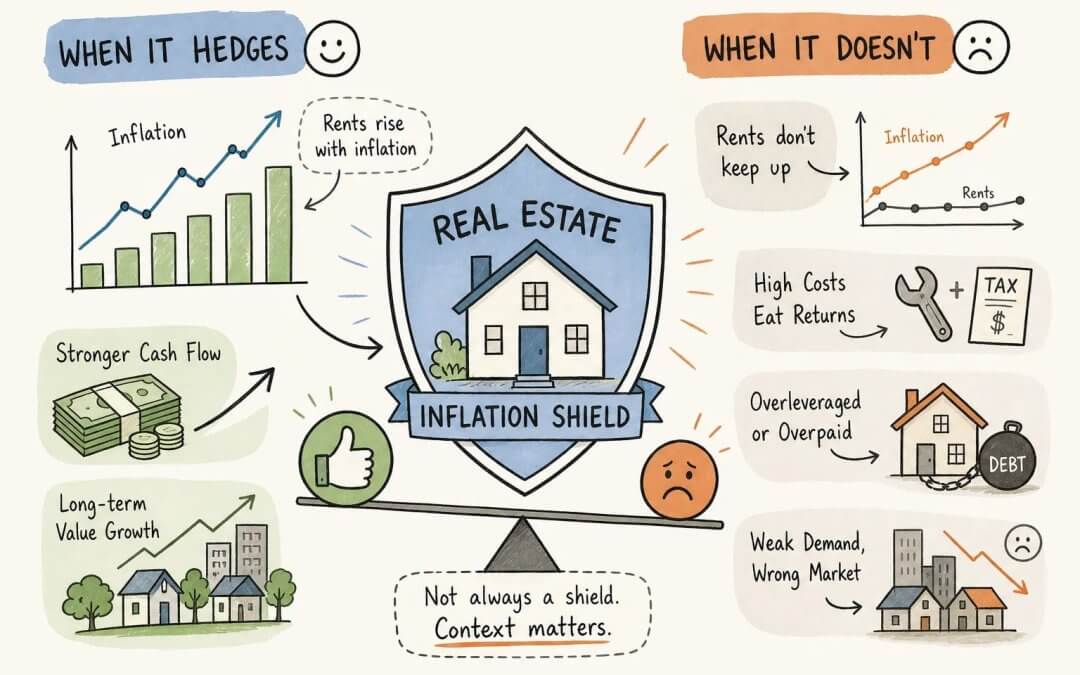
The honest answer is that real estate is a partial hedge, not a perfect one. The strength of the protection depends on the property type, the financing structure, the lease terms, and the local market. Get those right, and real estate is one of the most effective inflation shields available to individual investors. Get them wrong, and you’ve bought a real asset that still loses real value.
Real Estate Inflation Hedge: Core Mechanics
Before looking at data, it helps to understand the underlying channels. Real estate doesn’t hedge inflation by accident. Three specific mechanisms drive the relationship, and each one is more or less active depending on how the asset is structured.
Rents reprice faster than most investors expect
Residential leases typically run 12 months. That means landlords can reset rents annually to reflect current market conditions, which is the primary rental income inflation passthrough for single-family and multifamily rentals. This is an active repricing mechanism built directly into the lease structure. Self-storage and hospitality move even faster, sometimes repricing daily. The shorter the lease term, the more directly rental income tracks rising costs.
Property values and the hard-asset advantage
Physical property holds intrinsic value tied to land, construction costs, and replacement cost, all of which rise with inflation. Unlike a bond or a savings account, a rental property’s underlying asset inflates alongside the general price level. In markets with strong population growth and constrained housing supply, that appreciation compounds meaningfully over time. The asset itself isn’t just holding value. It’s being repriced upward by the same forces driving the broader economy higher.
Fixed-rate debt becomes cheaper in real terms over time
This is the mechanism most investors underestimate. When you lock in a 30-year fixed-rate mortgage and inflation rises, you repay that loan in dollars worth less than when you borrowed them. The real burden of the debt shrinks without any action on your part. This leverage dynamic turns inflation from a liability into a quiet structural advantage for owners holding fixed-rate financing. It doesn’t show up on a spreadsheet the same way rent does, but over a decade-long hold, it’s one of the most powerful wealth-building effects in real estate.
What 30 Years of Data Actually Shows
The mechanics make sense in theory. The question is whether the numbers bear them out. The honest reading of the research is that real estate is a meaningful but imperfect inflation hedge, and the strength of the relationship varies considerably by property type, time horizon, and the nature of the inflation itself.
Residential property and CPI: the long-run track record
Studies consistently show a positive but imperfect relationship between residential real estate returns and CPI. Housing partially hedges inflation over 1-, 5-, and 10-year horizons, with the relationship strengthening over longer periods. In one widely cited body of private real estate research, capital appreciation shows roughly a 31% correlation with CPI, while income returns show a 17% to 27% correlation with quarterly CPI. Those numbers are meaningful. They’re also well short of a perfect hedge, which is the point: real estate moves with inflation, but it doesn’t move in lockstep.
Commercial real estate: a more nuanced picture
Commercial real estate shows a moderate positive correlation with core CPI over long periods, but the relationship weakens significantly when inflation is declining. Multifamily and industrial have historically been the strongest commercial real estate hedges. Office assets and properties with long lease terms lag because rent resets are infrequent. In one widely cited 44-year analysis of CRE returns, the inflation correlation approaches zero during falling-inflation regimes. The direct property inflation hedge is property-type specific, not sector-wide, and assuming otherwise is a common and costly mistake.
How the Real Estate Inflation Hedge Works for Short-Lease Assets vs. REITs
REITs are listed securities. They respond to equity market sentiment, interest rate expectations, and discount rate shifts, not just property fundamentals. During actual inflation spikes, REITs have shown negative inflation betas and behaved more like stocks than like real property. A 2025 international study found that direct real estate hedges inflation more consistently than listed real estate, particularly during turbulent periods when listed real estate’s protection can turn negative or insignificant. For investors who want genuine inflation protection, the vehicle matters as much as the asset class. Owning the building is different from owning shares in a company that owns buildings.
Which Property Types Work Best as a Real Estate Inflation Hedge
Not all real estate performs equally as an inflation hedge. The lease structure determines how much of the inflation environment actually flows through to the owner’s income, and the differences between property types are substantial.
Short-lease assets: where the protection is strongest
Multifamily apartments, self-storage, and hospitality sit at the top of the inflation-protection spectrum because they reprice most frequently. Industrial and single-tenant net-lease commercial also perform well, with CPI-linked escalation clauses and expense pass-throughs that shift rising costs directly to tenants. Triple-net leases are particularly effective: operating cost inflation lands on the tenant, not the landlord. Fixed escalations in commercial leases typically run 3% to 5% annually, and CPI-indexed clauses provide direct protection when inflation runs hot. These structures were designed specifically to protect income from inflation erosion.
Long-lease office and retail: where the hedge weakens
Office leases with five- to ten-year terms delay rent resets significantly. If inflation surges mid-lease, the landlord is locked into below-market rent until renewal, with no mechanism to close the gap. Percentage rents in retail add some indirect inflation exposure through tenant sales volume, but they don’t fully compensate for a sustained inflationary period. This is where the assumption that “all real estate hedges inflation” collapses in practice. The asset class works; specific assets within that class may not.
The Risks That Can Undercut the Hedge
Inflation creates two competing forces for real estate owners simultaneously. Rising inflation tends to push rents and property income higher, which benefits owners. It also tends to push interest rates higher, which compresses valuations and increases financing costs. Which force dominates determines whether the hedge actually held.
Rising cap rates and the math of property valuation
The math here is straightforward and unforgiving. At a 5% cap rate, a property generating $100,000 in net operating income is worth $2,000,000. If the cap rate rises to 6%, that same income stream is worth $1,670,000, a 16% drop in value with zero change in income. During the 2022 to 2024 Fed rate hiking cycle, multifamily cap rates expanded from roughly 4.5% to 5.75%, implying an approximate 22% decline in value. Investors using significant leverage were most exposed because higher borrowing costs compounded the valuation compression. Single-family rental values were more resilient, partially cushioned by home-price appreciation, but they weren’t immune.
When rent growth can’t keep pace with inflation
The research is consistent on one point: real estate hedges expected inflation more reliably than unexpected inflation shocks. When inflation accelerates faster than anticipated, leases already in place can’t adjust, and local market conditions may not support the rent growth needed to close the gap. In some Sun Belt markets by 2026, asking rents were actually declining year-over-year after peaking in 2022 to 2023, even while cumulative shelter inflation remained substantially elevated. Rent control laws, rising vacancy, and weak local demand can all sever the rent-to-inflation connection. Market selection isn’t a secondary consideration, it’s where the protection actually lives or dies.
How to Position Real Estate as an Inflation Hedge in 2026
The mechanics and the risks are both clear. What remains is translating the analysis into decisions that actually hold up.
Lock in fixed-rate financing and hold through rate cycles
The fixed-rate debt advantage only works if you actually use fixed-rate debt. Adjustable-rate mortgages eliminate one of real estate’s core inflation-protection mechanisms entirely. In a 2026 environment where rate direction remains uncertain, locking in 30-year fixed financing insulates investors from future rate risk while preserving the real debt-reduction benefit. Long hold periods amplify the effect. The investor who refinances or sells every three years captures very little of this advantage; the one who holds for ten or fifteen years benefits from years of debt-burden compression.
Prioritize markets where rent growth consistently beats inflation
Not every market delivers rent growth that outpaces CPI. The Midwest led annual rent growth into mid-2026 at roughly 2%, while some Sun Belt markets were posting year-over-year declines. High-demand markets with population inflows, constrained housing supply, and diversified job growth have historically outperformed national rent averages over full cycles. Investors need metro-level data, not national averages, because the inflation hedge in real estate is always a local story. A property in a declining-population market with weak demand isn’t a real estate inflation hedge regardless of how well the national numbers look.
How the Empowered Investor Network identifies those markets
This is where the research advantage matters in practice. The Empowered Investor Network maintains a national network of local market specialists and dedicated investment counselors who evaluate specific markets against exactly these criteria: rent growth trends, population dynamics, housing supply constraints, and cash-flow fundamentals. For investors in high-cost coastal states who can’t access local investment properties at workable numbers, vetted deal flow in affordable Sun Belt and Midwest markets is the practical difference between owning a genuine inflation hedge and simply owning a property. Investors interested in current vetted market recommendations can connect with the network’s investment counselors directly to walk through their current position and which markets fit their situation.
The Hedge Is Real, But It’s Not Automatic
Real estate is not a perfect inflation hedge. The research is clear on that, and any advisor who tells you otherwise is selling something. What it is, though, is one of the most reliable inflation-protection tools available to individual investors when the right conditions are in place. Short leases, fixed-rate debt, and strong local demand are the conditions that make the hedge work. Long leases, variable-rate financing, and weak markets are the conditions that make it fail.
The investors who have used real estate most effectively as an inflation hedge over the past several decades weren’t just buying property. They were buying the right property, in the right market, with the right financing structure, and holding it long enough for the mechanics to do their work. That’s a discipline, not a guarantee. The difference between those two things is what separates investors who actually protected their wealth from inflation from those who just thought they did.